
The Last Musician of Auschwitz Named One of The Guardian’s 50 Best TV Shows of 2025
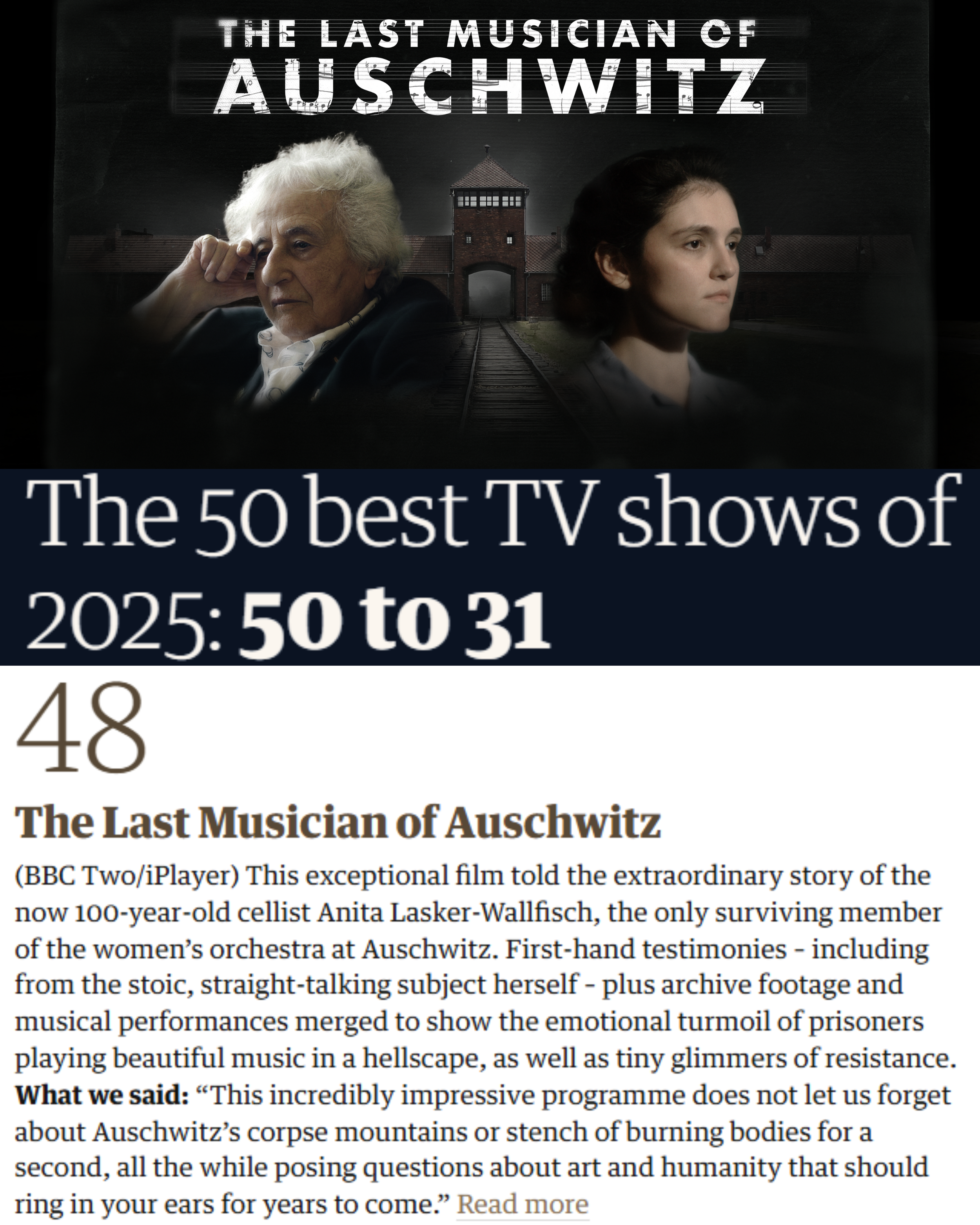
We’re proud to share that The Last Musician of Auschwitz, produced with Two Rivers Media, has been included in The Guardian’s list of the 50 Best TV Shows of 2025 - read the full article here.
How can there be music in the worst place in the world? This is the question The Last Musician of Auschwitz answers in a film marking Holocaust Memorial Day 2025. Told through the words of victims of the camp who played and created music during the terrors of the Holocaust, it shows how, in the most brutal and dehumanising situations, music could be a lifeline, a way to give testimony and even a way to resist.
At the film’s heart is Anita Lasker-Wallfisch’s story. As a teenager in Germany, Anita - like millions across Europe - faced persecution by the Nazis, who were determined to rid Europe of its Jews. Eventually she was sent to Auschwitz, the largest concentration and extermination camp in the Third Reich. Now 99, Lasker-Wallfisch recalls how a chance mention that she played the cello saved her life, offering her entry into the camp’s official women’s orchestra. This was one of fifteen orchestras the SS set up across the complex. Their function: to play marches as the camp’s slave labour force went to and from work, and to entertain Nazi personnel at concerts and private recitals.
Woven throughout are new interpretations of musical works written by victims of the camp, mainly filmed at resonant locations in the environs of Auschwitz today. Between them they touch on themes of loss, longing and cultural memory and address head on the barbaric and murderous regime at Auschwitz.
Anita Lasker-Wallfisch reflects on the indignities and horrors of camp life, and the terror of playing a solo for Dr Mengele, the camp doctor notorious for his ‘experiments’ on children. The film features a performance of Traumerei (Dreams), from Robert Schumann’s Scenes from Childhood, which just over eighty years ago Mengele demanded she play, performed here by her son and professional cellist, Raphael Wallfisch.
Also featured is the story of Polish political prisoner Adam Kopyciński, a conductor of the first orchestra at Auschwitz. For Kopyciński, music offered a psychological lifeline, allowing him and his fellow musicians a means briefly to take their minds away from the atrocities all around. This is evident in his Lullaby, the rare handwritten manuscript of which survives today. In the film, the piece is evocatively played at night in the grounds of the former camp commandant’s house, adjacent to the camp itself.
In addition, the film highlights the life and work of Polish composer Syzmon Laks, deported as a foreign Jew from Paris and sent to Auschwitz. He too attributed his survival to his position in a camp orchestra. Unlike Kopyciński however, he always maintained that music offered little ‘spiritual’ benefit even to musicians. His son André suggests that at Auschwitz Laks developed his Third String Quartet based on Polish folk tunes – a small act of resistance, asserting his national identity, despite the Nazis’ efforts to stamp it out. The film features its plaintive second movement, staged at dusk against the haunting backdrop of watchtowers, barbed wire and rows of barracks.
The story of Czech and Jewish songwriter Ilse Weber forms another strand of the film. Drawing on her letters to a friend, it reveals her pain at sending her eldest son on the Kindertransport to safety. Later it tells how while being held in the Theresienstadt ghetto, Weber drew strength from writing songs for children she tended as a nurse there. The film reveals how she sang to them and her remaining son Tommy, even as they entered the gas chambers at Auschwitz. The film features two of Weber’s most moving works: ‘And the Rain Falls’, inspired by her absent son, and ‘Wiegala’, a poignant lullaby.
The film also highlights the Nazis’ persecution of Roma and Sinti people, sent in their thousands to Auschwitz, and eventually, most to the gas chambers. Expert musicologist Petra Gelbart, herself of Roma descent, sings a song (‘There is a Big House in Auschwitz’) believed to have been created at the camp and passed down through her family. It is a powerful testimony about the camp - the horrific conditions, incidence of rape and the persistent threat of death.
An emotional rendition of the Jewish Deathsong ends the film. A reworking of a traditional Yiddish folk song, devised by Berlin choir master Martin Rosebury D’Arguto in the days before he too was sent to Auschwitz, it testifies to the intended annihilation of the Jews. It was memorised by his friend Aleksander Kulisiewicz who later shared it with the world, adamant it must never be forgotten.
Ultimately The Last Musician of Auschwitz casts a fresh light on the place of music in one of the darkest periods of twentieth century history, commemorating its victims and reflecting on the power music had, amidst a cacophony of pain and degradation, to offer a note of defiance and hope.
Congratulations to the entire team involved for bringing these stories to life.